Artificial intelligence, made operational.
Capabilities
AI Strategy & Operating Model: A portfolio you can fund, staff, and govern.
AI strategy starts with the work, not the model. We map where time, judgment, and margin are being lost; size the opportunity; and select a focused portfolio of use cases against value, feasibility, risk, and data readiness.
Then we define the operating model around it: owners, decision rights, build-or-buy boundaries, governance, metrics, and a 90-day sequence. The strategy becomes an accountable program instead of an innovation deck.
- Workflow diagnostic, value sizing, and risk assessment
- Use-case portfolio, sequencing, and build-or-buy decisions
- Operating model, governance, investment case, and KPIs

Applied AI Research: Research that earns the right to become a system.
Some AI questions cannot be answered through vendor selection or a workshop. We run focused technical research to test model behavior, architectures, interaction patterns, and economic assumptions against the environment they will actually face.
Each research sprint ends with evidence: a benchmark, a working prototype, documented failure boundaries, and a clear decision to build, change course, or stop.
- Model and architecture experiments with comparative benchmarks
- Rapid prototypes and human-in-the-loop studies
- Reproducible test harnesses and go-or-no-go decisions
Workflow Automation: Remove the handoffs, not just the keystrokes.
The highest-value automation rarely lives inside one task. We map the full workflow across systems, approvals, exceptions, data movement, and human judgment, then redesign it around AI where it improves speed, quality, or capacity.
We build dependable automations with clear escalation paths, observability, and recovery. The result is a workflow people can operate, not a demo that breaks the first time reality leaves the happy path.
- End-to-end workflow mapping and automation economics
- Integrations, orchestration, approvals, and exception handling
- Monitoring, audit trails, fallbacks, and operator playbooks
Agentic Systems: Agents with jobs, tools, boundaries, and supervision.
An agent becomes useful when it can carry responsibility across steps: gather context, use tools, make bounded decisions, coordinate with other agents, and know when to return the work to a person.
We design and deploy single- and multi-agent systems around explicit authority, memory, observability, cost, and failure modes. Then we test them under real operating conditions before they are trusted with production work.
- Agent roles, tools, permissions, memory, and orchestration
- Human-in-the-loop controls, traces, and operator interfaces
- Production integration, cost testing, and adversarial evaluation

Data & Knowledge Infrastructure: Give AI the context your best people already carry.
Models are abundant; reliable organizational context is not. We connect documents, databases, policies, decisions, and live systems into a governed knowledge layer that returns the right evidence with provenance.
That may mean retrieval, knowledge graphs, semantic search, data pipelines, or structured memory. We design for freshness, permissions, and feedback so the system becomes more useful without becoming less trustworthy.
- Data and knowledge-source inventory, quality, and readiness
- Retrieval, knowledge graphs, semantic search, and memory
- Permissions, provenance, refresh pipelines, and evaluation
Evaluation, Safety & Governance: Know how the system fails before the business does.
AI systems need more than an accuracy score. We define the behaviors that matter, build scenario-based evaluations, probe for adversarial and operational failure, and instrument production quality, cost, and drift.
Governance is attached to actual risk: who can approve what, what evidence is retained, when a human must intervene, and how incidents are handled. Controls live inside the system and workflow, not in a policy binder beside them.
- Task-specific evaluations, red teaming, and model comparison
- Security, privacy, bias, and operational failure-mode review
- Approval gates, monitoring, incident playbooks, and audit evidence

Growth & Marketing Systems: A growth engine that learns between campaigns.
AI does not replace positioning or judgment. It makes the work around them faster, more responsive, and measurable. We connect market signals, customer data, content operations, campaigns, sales feedback, and lifecycle programs into one operating system for growth.
We build workflows that turn a brief into tested creative, personalize within brand and compliance boundaries, route leads with context, and feed performance back into the next decision. Teams retain editorial control; automation carries the repetitive coordination.
- Audience intelligence and campaign-planning workflows
- Content supply chains, brand-safe generation, review, and localization
- CRM orchestration, lead intelligence, and campaign learning loops
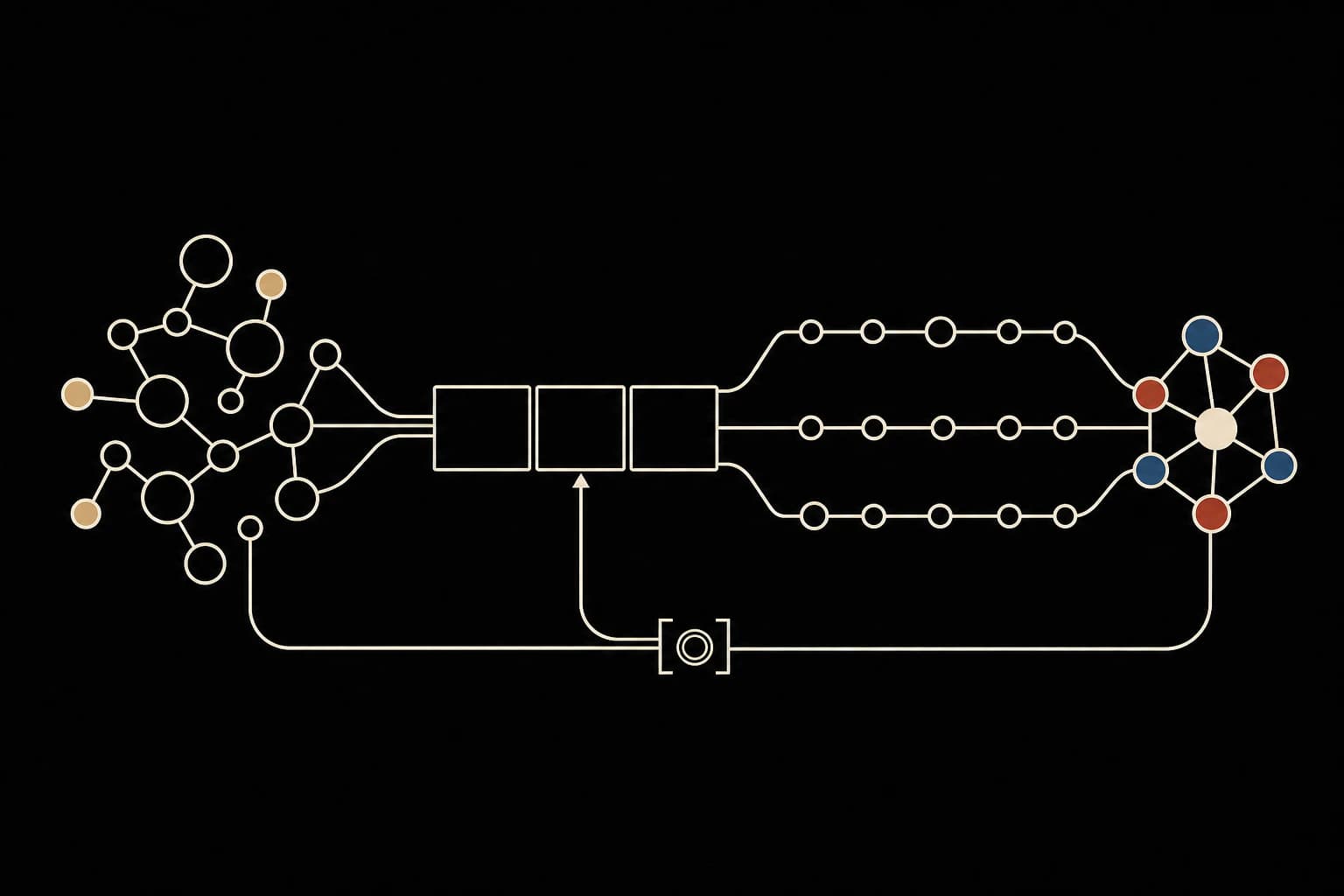
AI Implementation & Adoption: From working prototype to work people actually use.
Production is where the hard questions arrive: security, integration, latency, cost, ownership, training, and the exception nobody designed for. We carry promising prototypes through those constraints and into dependable use.
We work inside the delivery cadence, instrument outcomes, train operators, and transfer the system with documentation and clear ownership. The engagement ends when the capability is live and the team can improve it without us.
- Production architecture, integrations, deployment, and hardening
- Pilot design, change management, training, and adoption measurement
- Runbooks, ownership transfer, roadmap, and continuous improvement